Getting Organised to Work Online

I’ve run successful ‘offline’ businesses and know what how much time, effort and organisation that takes.
So why haven’t I yet been able to do this for an online business?

Last year I attended Chris Freville’s “7 Figure Success Formula” course.
And one of the first things Chris advised was to ‘get organised’ and chunk down tasks into manageable one hour blocks.

Sounds easy.
Just like a training book I read over 10 years ago that started off by saying ‘make $1 passive profit online’ on page one followed by 200 pages explaining how to scale it up! Even today, I haven’t discovered a way to do that without hard work.

There are so many easy excuses I could make – shiny new ideas and toys, far too much for any one person to ever learn etc. etc.
But none of that helps to make me more productive or able use my time to earn more $ cost effectively.

I’m working harder than I have ever worked before – often 12 to 16 hours a day.
But never seem to find enough time to do all the things that are really necessary.

So today, I took a step back and decided to research Project Software.
Like most things online, I quickly became bewildered with all the possibilities and baffled by what software is really ‘free’ or a reasonable cost.

Programs such as Microsoft Project are far too expensive and cumbersome for a one man business plus the work I outsource – mainly graphics.

A Google search quikly led me to a Wikipedia page listing 140 different software products.
Quickly selecting a few free products to investigate further, I wasted a lot of time discovering most weren’t actually free – versions of interest needed to be paid for ant typically $25 a month!
And they had far too many features taking lots of time to learn.

I wouldn’t mind paying a one off fee of $25 or even $50 – but have no interest forking out $100’s or making ongoing monthly payments.

One thing that did surprise me was that almost all Project Software is now web hosted.

Next I focussed on software with open source GPL licenses.
The biggest problem I found was that most of the software was old, no longer supported or wouldn’t work with operating systems later than XP – such as Windows 7.

But in the end persistence paid off!
I found a site that explained a couple of products were readily available for installation using my hosting cpanel and Fantastico or simple scripts!
How I kicked myself for not thinking of that to start with.

Firing up cpanel on one of my hosting accounts, sure enough two open source Project scripts were available for instant installation – almost exactly the same way as a wordpress blog is installed.
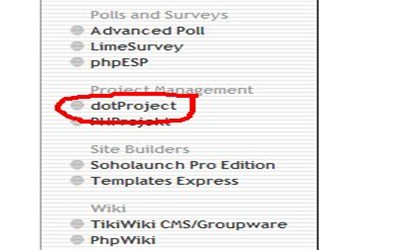
Fantastico's Project Scripts

Fantastico’s Project Scripts

Five minutes later I had not only installed dotproject but also fired it up and got started using it – just following my nose, without bothering looking for any manuals.
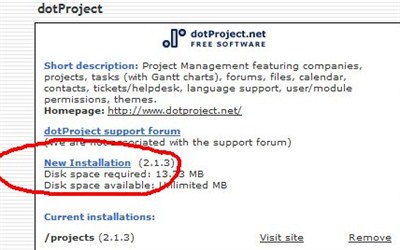
Starting dotProject Installation

Starting dotProject Installation

I decided to install the script in a folder called ‘projects’ on an unused domain:
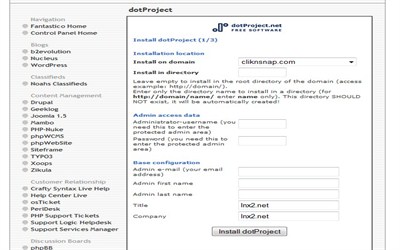
dotProject and wordpress Installations are alike

dotProject and wordpress Installations are alike

Now I’m busy setting up projects and tasks – already I can see just how many different things I am trying to do and how many hours it will take.

Hopefully this will help me focus on my most important tasks and reduce time I spend on other less important ones.
Tomorrow I’ll let you know how I’m getting on.

How WordPress Site Ranking Improves with Each Blog Post

When I started out working online, I created lots of niche blogs.
The aim was to get each one ranked on page one of Google for relevant keywords.

What I found extremely frustrating was the amount of hard work needed with no real sign of progress. Traffic was very erratic.
How I would have loved to get some measure of progress and value for each blog post.

Instead, I spent hours checking how each site was ranked by Google – a very rough and ready process lacking any reliable repeatable results.

Last year I invested in Chris Freville and Paul Teague’s 7 Figure Success Formula.
Their recommendation was to monitor progress using Alexa..com
That’s what I have been doing for this site for the last few weeks.

I have not bothered to focus on SEO or any particular keyword yet – not driven any traffic here. So the site doesn’t bother using header tags for keywords – because I am not targeting any yet.
stevemackay.com had nothing other than a virgin WordPress Blog for over a year.
Then on 19 April 2012 I reconstructed the site to follow John Thornhill’s One Month Mentor training course.

Initially I posted new content daily for a few weeks then started posting at less regular intervals.
To date I have posted 37 articles – averaging about one every 3 days.

Here’s what I have found:
stevemackay.com Alexa ranking was about 11,150,000 when I first checked a couple of weeks ago.
Each time I make a new blog post, the Alexa ranking goes up by about 15,000.

Google Analytics reports the small amount of traffic (apart from me!) rises then falls to about half if I don’t post for a day then almost disappears the day after.

There are about 185 million active websites online.
So achieving an Alexa ranking of about 1.8 million means being in the top 1% of sites – and hopefully making the sort of income earned by many of the top sites!

Failing to do anything special – such as adding backlinks or driving traffic – a rough and ready estimate suggests I would need about 623 blog posts to get to a top 1% position. This would take about 2 years with one post a day.
Maybe less posts are needed – because improvements to my Alexa ranking has actually been accelerating as I post more regularly?
Or maybe more posts are needed – because if things start to get tougher as ranking improves and competition becomes stronger.

Either way, Alexa seems to be a very useful and easy way to measure a site’s progress.

Does Training Quality Shrink with Quantity?

If you’re like me, you’ll value your time pretty highly.
And that presents a real problem when trying to learn something new.

You’ll need training to go into enough detail so you can understand it.
But you really don’t want it to go at such a snails pace that you switch off before it gets anywhere near explaining the bits you are really interested in.

For example, every week I am inundated with emails offering free webinars to learn how to make money online more easily, more quickly and with no risk.
Unfortunately they almost all overlook your most valuable resource – your time.

Usually I’ll sign up for two or three that promise to teach me something useful.
From maybe 6 hours of webinars, I’ll typically spend less than an hour learning the things I find useful.
Download my $17 report showing you “How to Save Half the Time You Spend Watching Webinars” while it’s still available at your favourite price = free.
And discover how I save myself hours of non-productive time each week.
No opt-in needed.


Cut Your Time In Half

Over the years I have listened to guru’s explaining the ways they make money online.
And I find most of them suggest methods that I am really not comfortable following.
For example, the first training course I spent $2000 on was from Ryan Deiss teaching how to make membership sites. Apart from recommending ‘forced membership opt-in’ Ryan also taught where to find free ‘filler content’ to use on your site to pad out the one or two high value unique products each month.

This may be a great easy way to avoid hard work.
But also a sure fire way to waste members time discovering real value in the content.

One of my favourite guru’s is Jason Fladlein.
Jason understands that something short, sharp and to the point has much higher value alternatives that are long and drawn out – whether webinars, ebooks, audios or videos.

Why do training webinars typically last 2 hours or more?
Most people’s attention span is limited to under an hour.
Sure the last 30 minutes is usually devoted to selling some product or service.
But can anyone keep providing high quality content for the rest of the time?
I don’t think so because it actually takes more time and effort to distil the essence of an idea to produce something brief and succinct yet keeping all essentials details.